
Open Interpreter
UNCLAIMEDCoding agent for open models
Overview
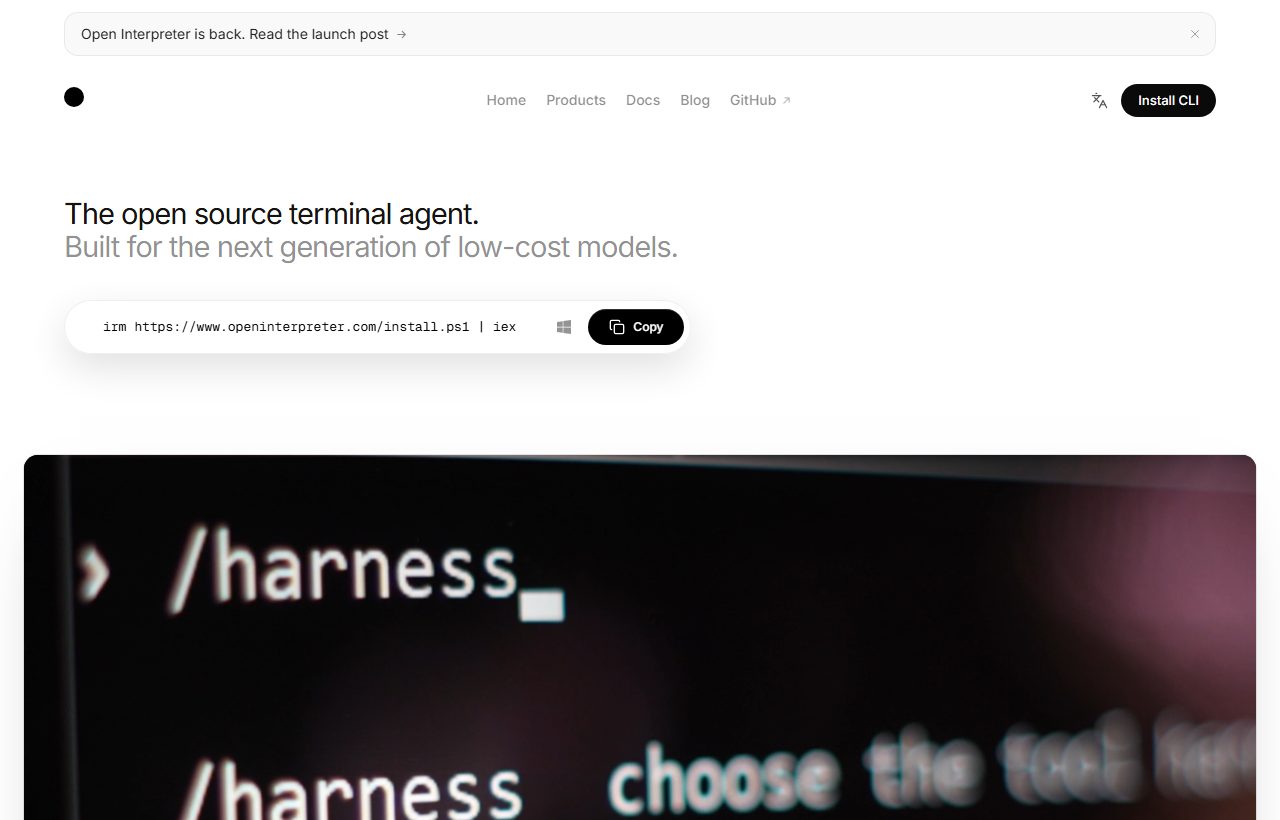
Open Interpreter is an open-source coding agent that runs in the terminal and is tuned for low-cost and open-weight language models. It can read files, edit code and execute commands inside native sandboxing on macOS, Linux and Windows. The current version is a Rust rewrite based on a fork.
About Open Interpreter
Open Interpreter is an open-source coding agent that runs in the terminal and is tuned for low-cost and open-weight language models. It can read files, edit code and execute commands inside native sandboxing on macOS, Linux and Windows.
The current version is a Rust rewrite based on a fork of OpenAI's Codex, replacing the original Python project, which now continues as a community-maintained fork. Its main idea is harness emulation: users can switch between agent harnesses modeled on tools such as Claude Code, Kimi Code, Qwen Code and SWE-agent to get better results from models like Kimi, DeepSeek, Qwen and GLM. Any OpenAI-compatible provider can also be used through Chat Completions.
Open Interpreter favors shared standards over a proprietary format. It reads repository AGENTS.md files and shared skills directories, supports MCP, hooks and permissions, works in editors that support the Agent Client Protocol, and speaks the Codex exec protocol so existing Codex SDK code can point to it with a one-line change. A built-in QA skill lets models test web and native apps. The project is released under the Apache-2.0 license.
Demo video Locked
Hidden until this listing is claimed The owner adds this when they verify Open Interpreter.
Claim to unlock →Open Interpreter homepage
✨ Key Features
Harness emulation
Switch agent harnesses to suit the model you are using.
Native sandboxing
Runs commands in sandboxes on macOS, Linux and Windows.
Any compatible provider
Use OpenAI-compatible providers via Chat Completions.
ACP editor support
Runs as an Agent Client Protocol agent inside editors.
Codex SDK compatible
Works with the Codex SDK through a one-line binary override.
Built-in QA skill
Lets models operate and test web and native apps.
🎯 Target Audience
Software developers
Read, edit and run code from a terminal agent.
Cost-conscious teams
Get strong agent results from low-cost models.
Open-model users
Run coding agents with Kimi, DeepSeek, Qwen or GLM.
Tool builders
Embed the agent via the Codex SDK or exec protocol.
QA engineers
Automate testing of web and native app interfaces.
⚖️ Pros & Cons
Pros
Cons
Founder / CEO Locked
Hidden until this listing is claimed The owner adds this when they verify Open Interpreter.
Claim to unlock →Pricing Prices from the maker · check the maker's own site for current plans
Free
$0
- Open Interpreter does not publish a plan table
❓ Frequently Asked Questions
Is Open Interpreter free?
Yes. Open Interpreter is free, open-source software under the Apache-2.0 license. You pay only for whatever model provider you connect.
Is Open Interpreter open source?
Yes. The source code is public on GitHub under the Apache-2.0 license.
What happened to the original Python version?
The current release is a Rust rewrite based on OpenAI's Codex. The original Python project lives on as a community-maintained fork.
Which models does Open Interpreter support?
It supports providers including Kimi, DeepSeek, Claude, Qwen and Z.AI GLM, plus any OpenAI-compatible provider through Chat Completions.
Can I use Open Interpreter in my editor?
Yes. It runs as an Agent Client Protocol agent, so ACP-compatible editors and clients can launch it.
What is Open Interpreter?
An open-source coding agent built for low-cost and open-weight models.
What are the key features of Open Interpreter?
Open Interpreter offers 6 main features. Harness emulation: Switch agent harnesses to suit the model you are using. Native sandboxing: Runs commands in sandboxes on macOS, Linux and Windows. Any compatible provider: Use OpenAI-compatible providers via Chat Completions. ACP editor support: Runs as an Agent Client Protocol agent inside editors. Codex SDK compatible: Works with the Codex SDK through a one-line binary override. Built-in QA skill: Lets models operate and test web and native apps.
How much does Open Interpreter cost?
Open Interpreter uses a Free pricing model.
What are the pros and cons of Open Interpreter?
Key advantages include: Free and open source under Apache-2.0; Optimized for inexpensive and open-weight models; Uses portable standards like AGENTS.md, MCP and ACP; Large community with tens of thousands of GitHub stars. Potential drawbacks: Terminal-first tool that requires command-line familiarity; You supply and pay for your own model provider; The Rust rewrite differs from the original Python version, which is now a separate community fork.
What type of tool is Open Interpreter?
Open Interpreter is listed under AI Agents on Ai Product Index.
SIDE BY SIDE
Open Interpreter vs Manus vs AI Skills Manager
See at a glance which tool leads on each point. ★ = best in row
| CRITERIA | O | M  Manus VERIFIED | A |
|---|---|---|---|
| Best for | Coding agent for open models | What can I do for you? | Skills Manager, Universal AI Agent Skills |
| Starting price | Free | Freemium | Free |
| Free plan | Yes | No | Yes |
| Verified listing | No | Yes ★ Only one | No |
| Pricing model | Free | Freemium | Free |
| Founded | 2023 ★ Longest running | 2025 | 2026 |
| Links | View listing | View listing | View listing |
REVIEWS
What people say about Open Interpreter
No reviews yet
If you have used Open Interpreter, yours would be the first. Create a free account to leave a review, or sign in if you already have one.
MORE LIKE THIS